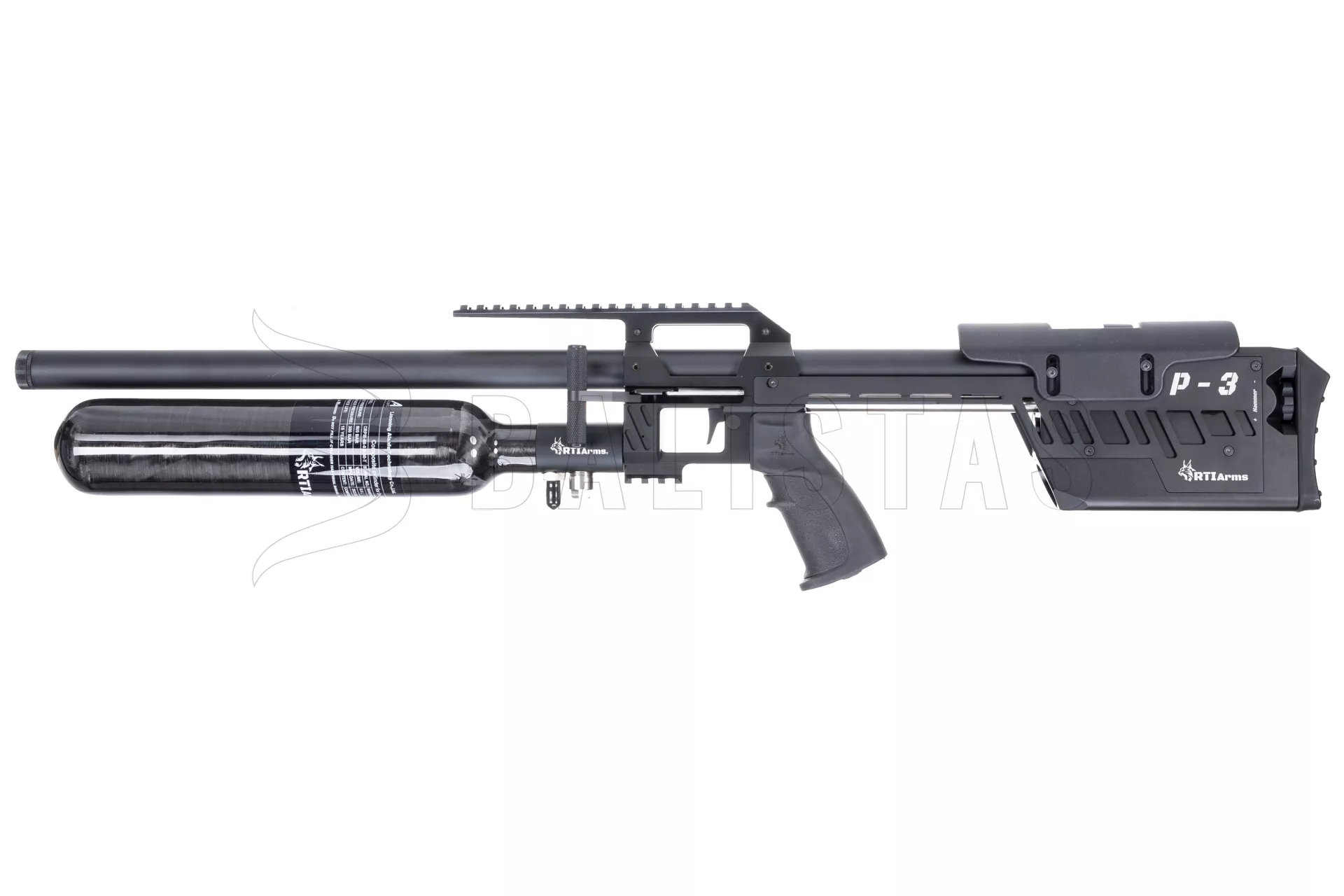
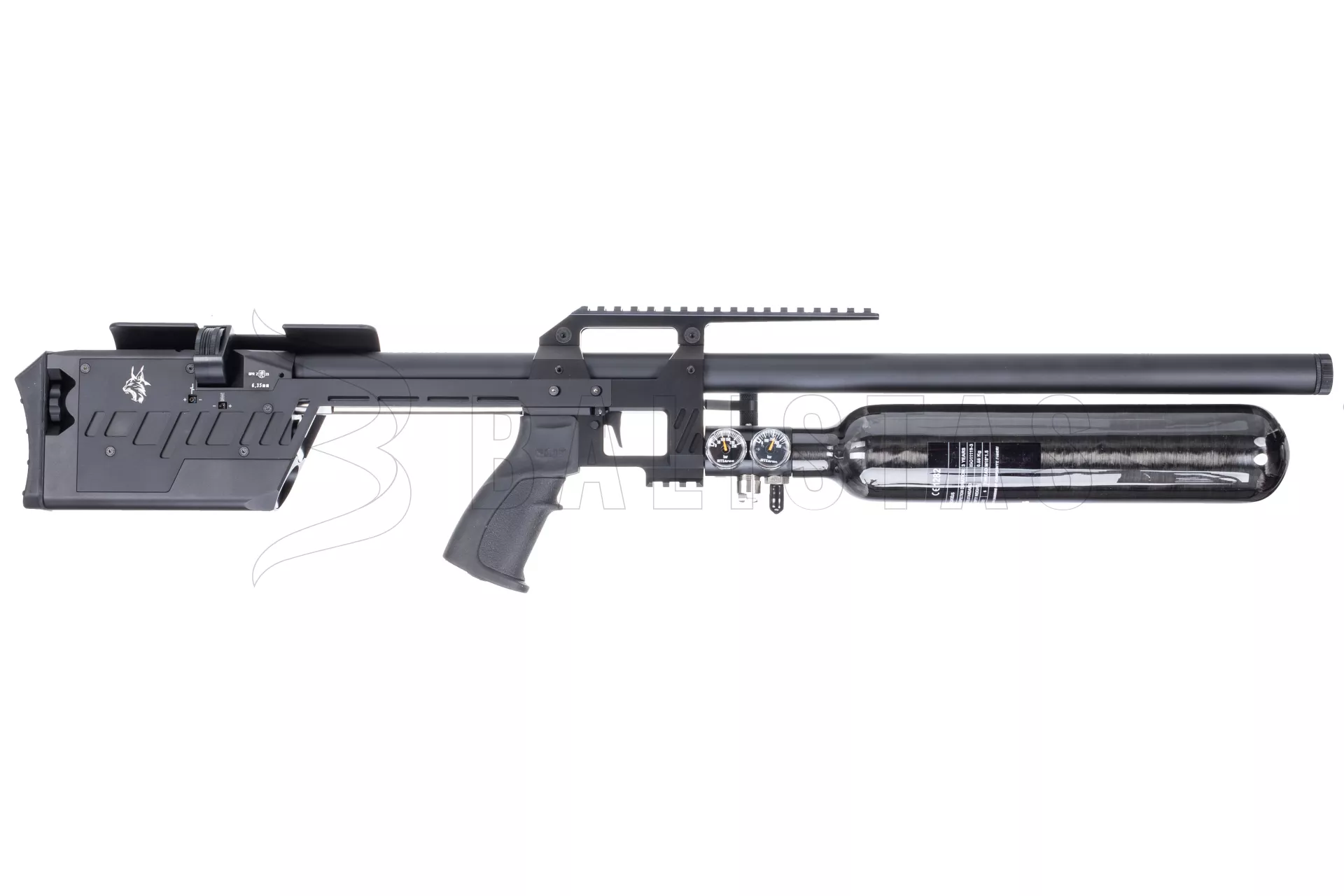
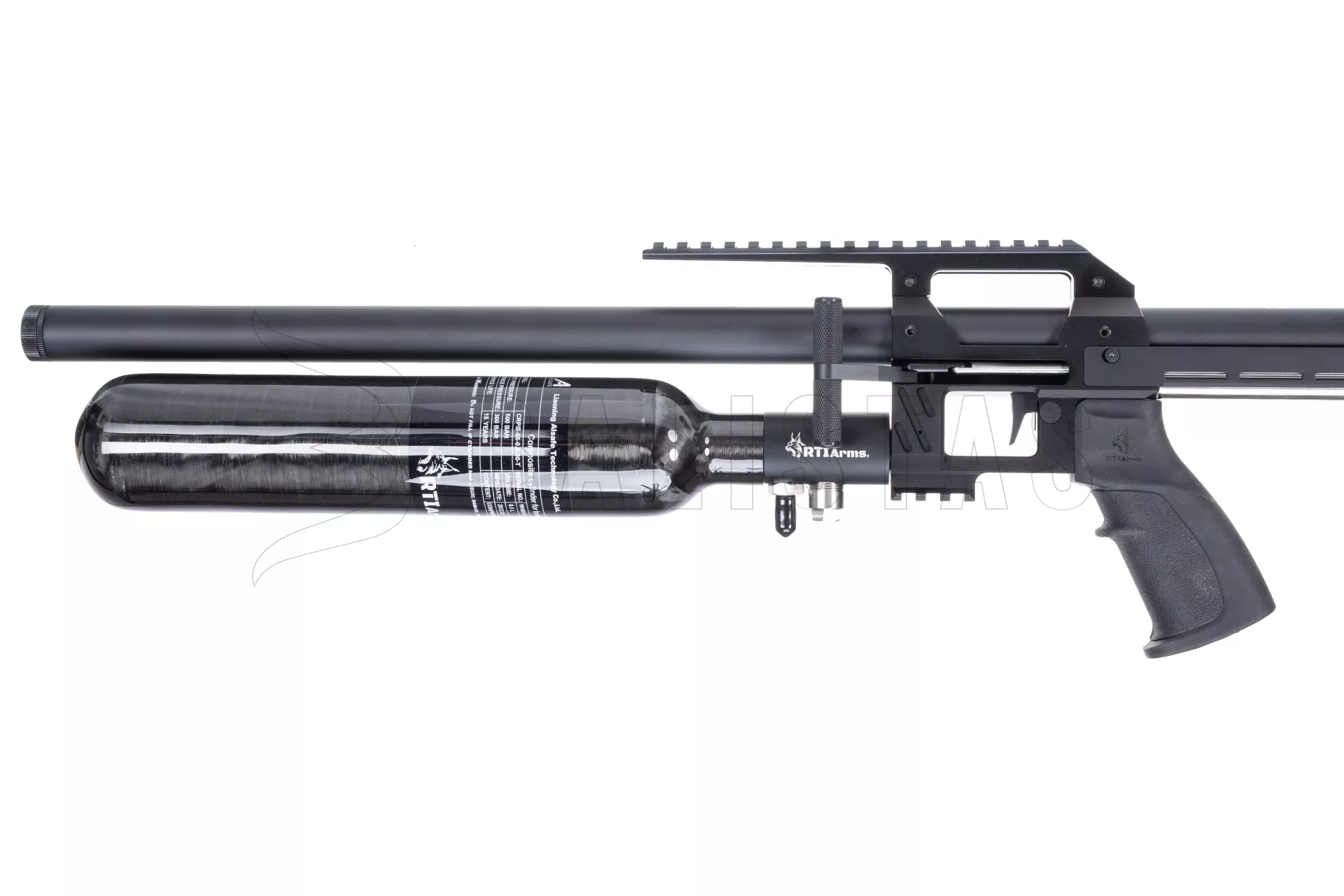
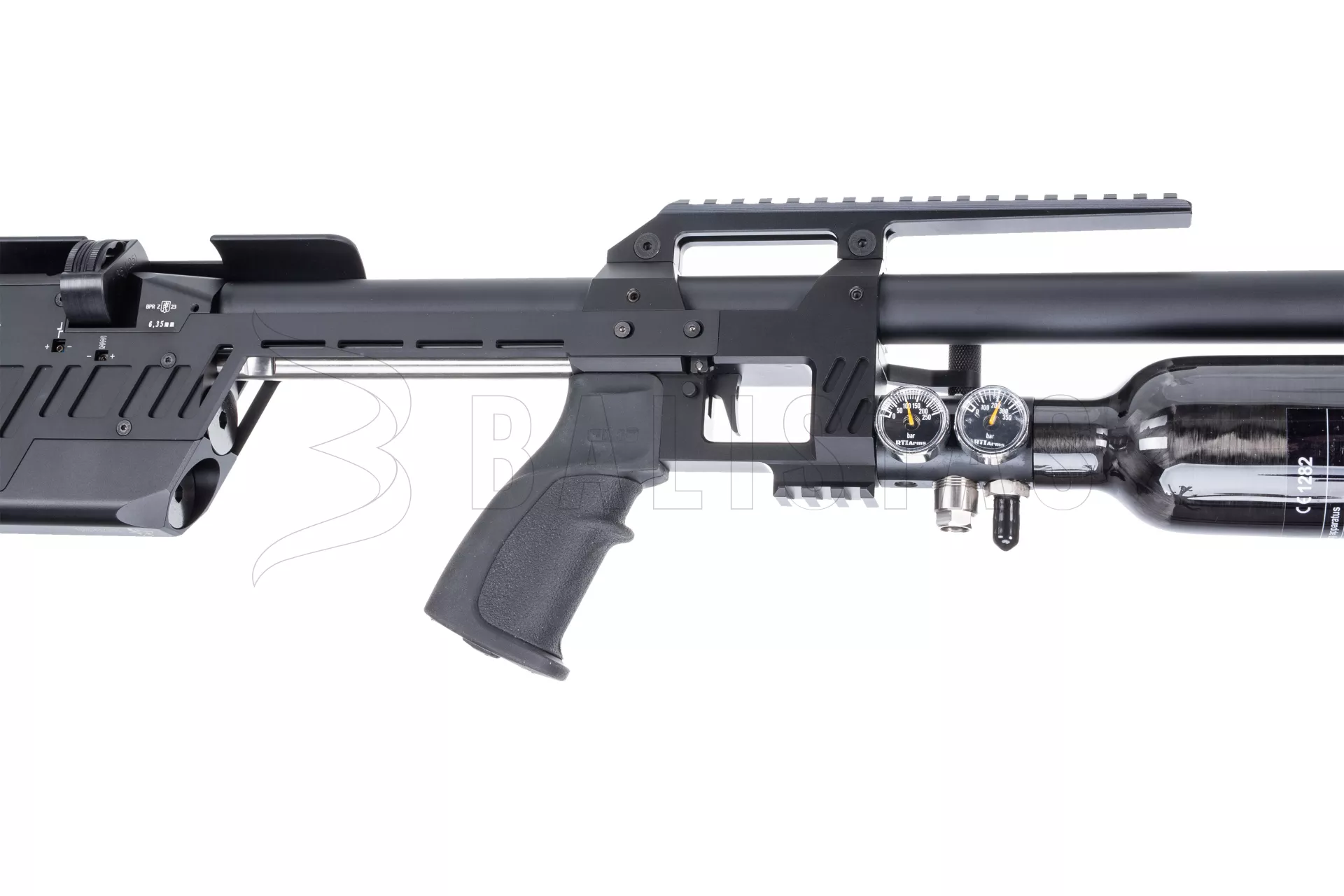
RTI Priest 3 Performance Bullpup PCP Air Rifle
€1,252.00
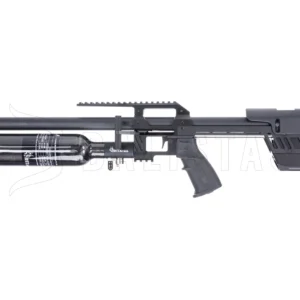
RTI Arms is proud to introduce the RTI P-3, the ultimate air rifle for those seeking the highest level of accuracy and overall performance.
The P-3 is an evolution from the Prophet II in terms of operation and functionality. It is easier to disassemble and more robust in its overall construction, with major upgrades and also several minor tweaks in different areas.
Continuing with its success with the .22 and .25 versions of the Prophet II, the P-3 is equipped with RTI’s proprietary barrel, the P-3 ensures outstanding accuracy with both pellets and slugs. As always with RTI, extreme accuracy is part of the essence of the P-3. That’s also why the trigger has been redesigned, delivering an even crisper and lighter pull.
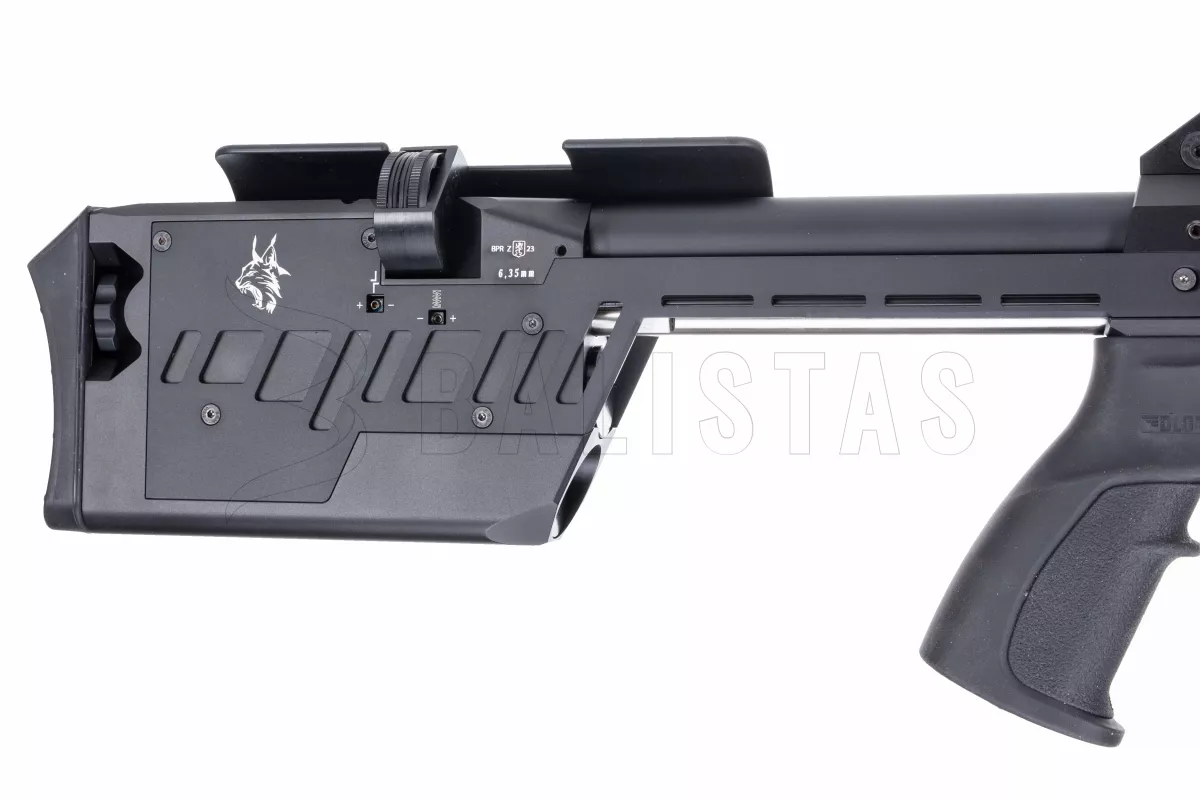
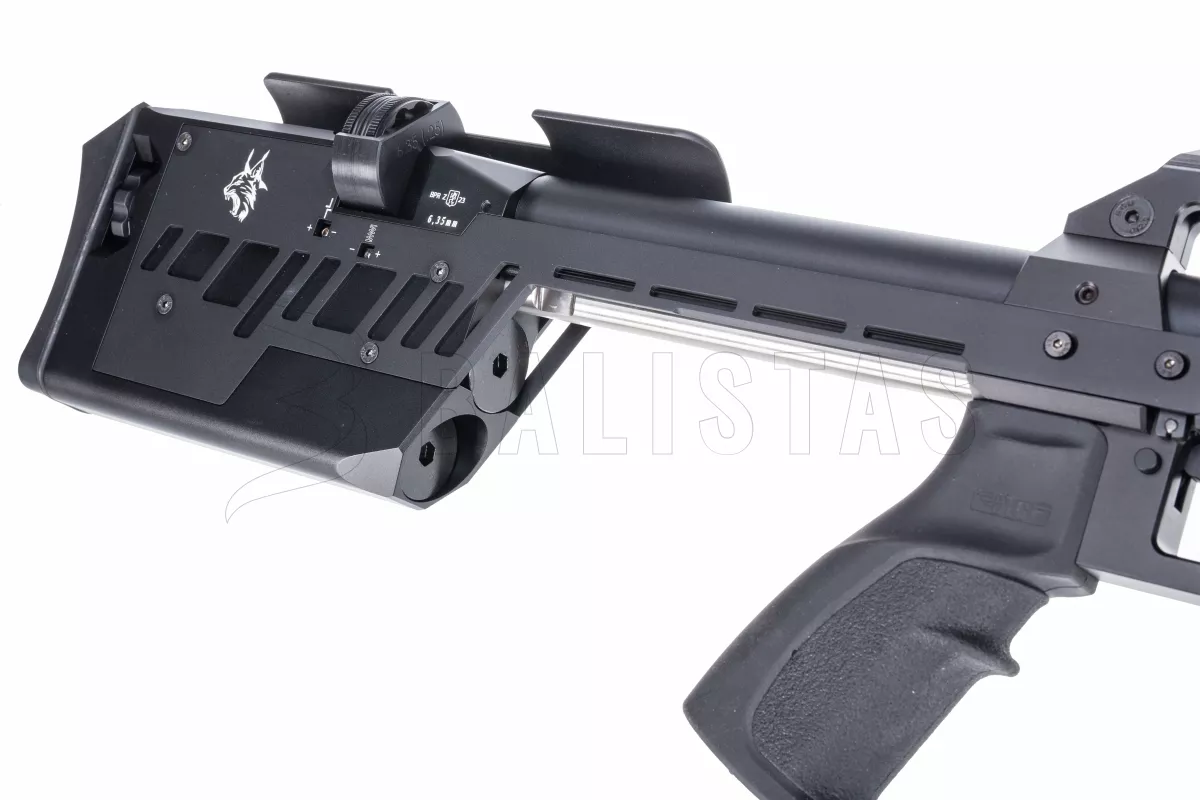
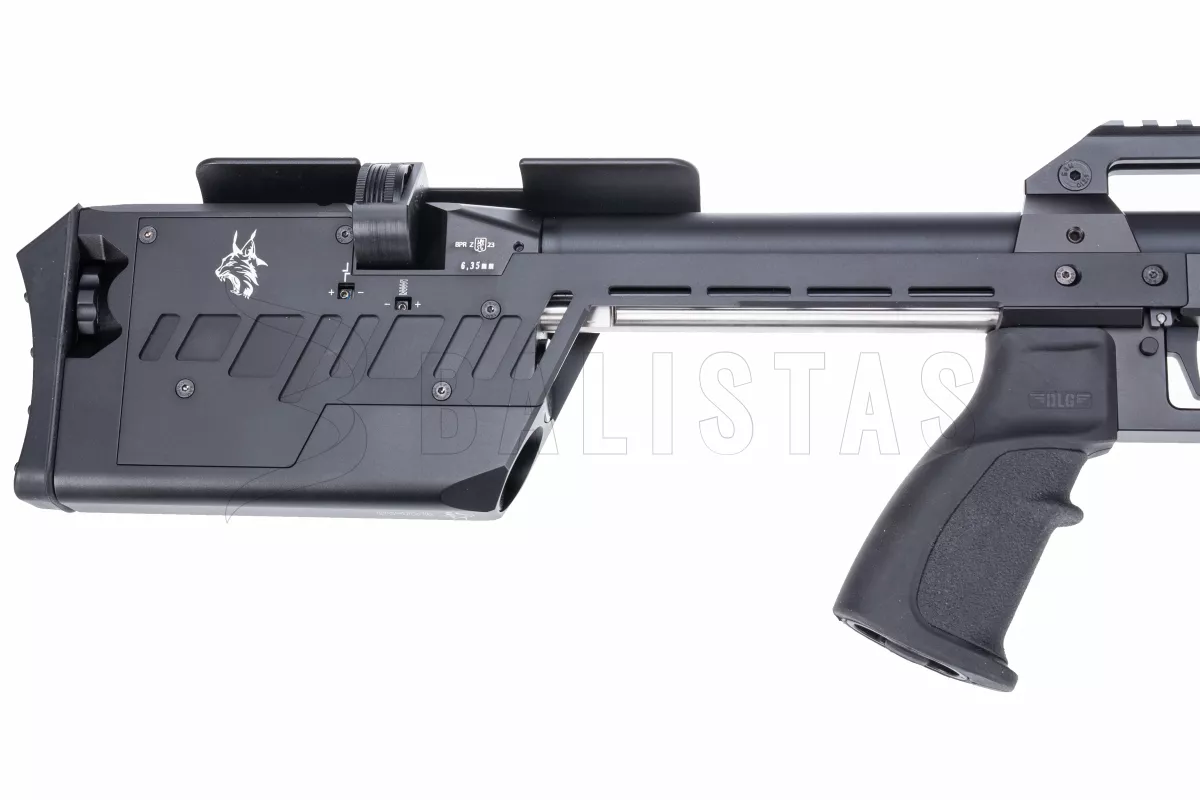
Power and efficiency have also evolved: the redesigned pressure-assisted valve system ensures rapid closure times, providing great energy efficiency, and delivering great power even at low pressures. Additionally, the micro-adjustable hammer tension can be easily adjusted with a simple wheel click, without requiring any tools.
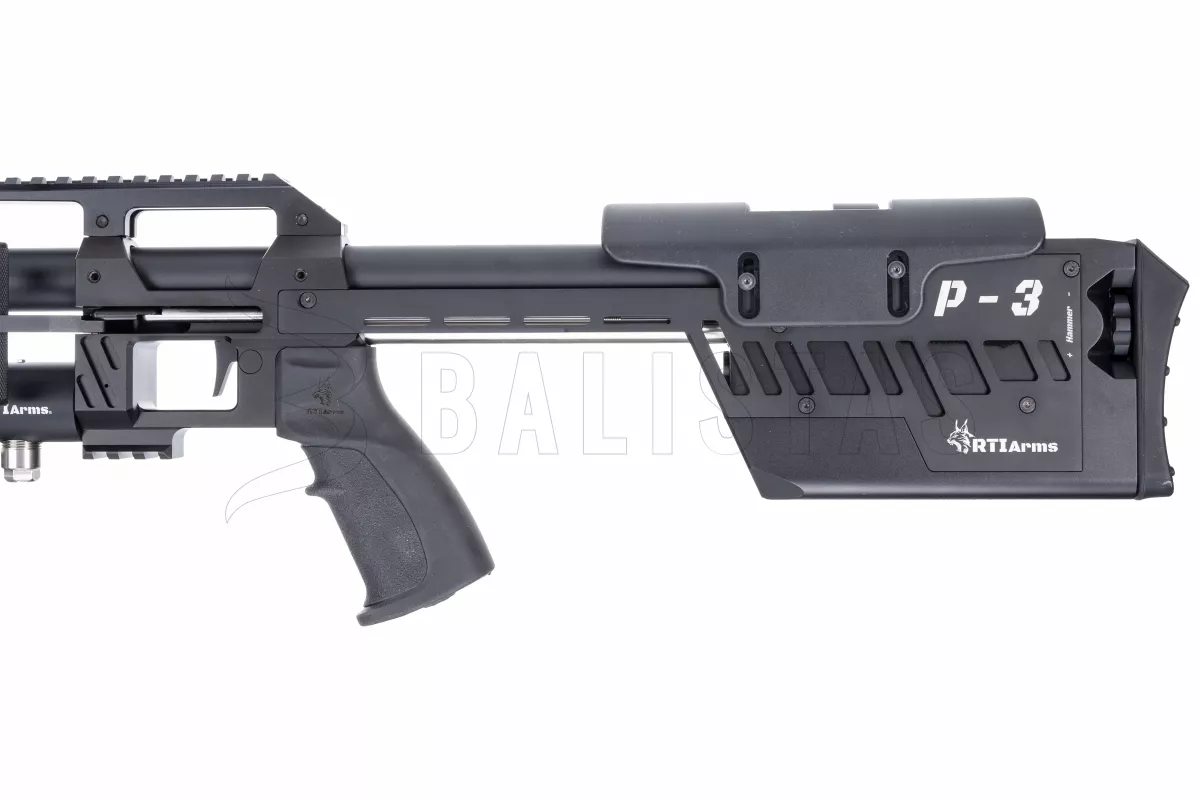
Ergonomics has also been an important area that has featured a marked evolution from the Prophet II. The P-3 features an adjustable ambidextrous cheek piece that allows for complete customization of the rifle’s fit, which combined with the rubber buttpad provides optimal comfort during use.
The P-3 is suppressor ready, with a 1/2″ UNF thread under the cap for easy installation. The infinitely adjustable 20-150 MOA Picatinny rail enables shooters to easily adjust the angle/elevation for extreme long-distance shooting. Plus, the ambidextrous magazine allows for left or right-handed shooting with ease.
Description
The RTI Priest 3 Performance Bullpup PCP Air Rifle
When precision, innovation, and raw power converge, they give rise to a masterpiece — the RTI Priest 3 Performance Bullpup PCP Air Rifle. Designed with competitive shooters and serious enthusiasts in mind, this air rifle transcends ordinary expectations. It’s not just a tool for precision shooting; it’s a statement of engineering excellence, built to dominate the modern PCP airgun landscape
A New Benchmark in PCP Engineering
The RTI Priest 3 represents the third evolution of RTI Arms’ celebrated Priest platform. Each iteration refined the legacy of precision, compact performance, and consistent accuracy. The “Performance” designation is not marketing flair — it signifies a fundamental leap in efficiency, modularity, and control.
Unlike many PCP bullpups that sacrifice ergonomics for compactness, the Priest 3 Performance achieves a flawless equilibrium between balance, comfort, and energy output. Every component is engineered for consistency — from its CNC-machined aluminum chassis to its adjustable regulator system, precision-matched hammer spring, and advanced barrel alignment system.RTI Priest 3 Performance
Transitioning from the earlier Priest 2 model, the third generation introduces enhanced modular architecture, optimized air routing, and superior shot-to-shot stability — resulting in tighter groupings and greater reliability under competitive pressures.RTI Priest 3 Performance
RTI Priest 3 Performance Compact Bullpup Design — Balanced, Stable, Efficient
Every curve and contour of the RTI Priest 3 is deliberate. Its bullpup configuration moves the action rearward, reducing the rifle’s overall length without compromising barrel size. This design philosophy provides maximum maneuverability in confined spaces — whether during tactical field competitions or precision benchrest shooting.
-
Compact Form Factor: 715 mm total length
-
Optimized Center of Gravity: Exceptional pointability for rapid target transitions
-
Adjustable Cheek Rest and Butt Pad: Tailored comfort for shooters of varying preferences
-
Lightweight Construction: Machined aluminum body for durability without excess mass
These elements combine to ensure that the RTI Priest 3 is as effortless to control as it is accurate.RTI Priest 3 PerformanceRTI Priest 3 Performance
Regulated Power Delivery
Consistency defines precision shooting. RTI Arms engineers recognized that even minor fluctuations in pressure can translate into measurable point-of-impact deviations. To counter this, the Priest 3 integrates an adjustable precision regulator, enabling shooters to fine-tune air output to match pellet weight, caliber, and shooting conditions.
-
High-Pressure Air Reservoir: 300 BAR carbon fiber cylinder
-
Adjustable Regulator System: Customizable output from 100 to 180 BAR
-
External Regulator Access: Simplifies adjustments without disassembly
The result? Every trigger pull delivers a predictable, uniform shot profile, maintaining energy stability across the entire fill range.RTI Priest 3 Performance
The Barrel System — A Core of Accuracy
At the heart of any precision rifle lies its barrel. RTI Arms equips the Priest 3 Performance with a Cold Hammer-Forged, Free-Floating Barrel, available in multiple calibers (4.5mm / .177, 5.5mm / .22, 6.35mm / .25, and 7.62mm / .30). This ensures not only flexibility in configuration but also match-grade performance across disciplines.
Key Barrel Advantages:
-
Free-Floating Design: Eliminates mechanical stress for improved harmonics
-
Threaded Muzzle End: Compatible with moderators and muzzle devices
-
Caliber Modularity: Easily interchangeable barrels for multi-discipline use
-
Precision-Crowned Barrel Tip: Ensures stable pellet exit trajectory
These features underscore RTI’s philosophy — control every variable, eliminate every inconsistency.
RTI Priest 3 Performance Trigger System and Ergonomics
Two-Stage Match-Grade Trigger
The Priest 3 Performance integrates a refined two-stage adjustable trigger, engineered for crisp let-off and minimal travel. This is not a trigger that surprises the shooter — it communicates. Each stage delivers tactile feedback, empowering the marksman to anticipate the break point intuitively.RTI Priest 3 Performance
-
Pull Weight Adjustment: Fully customizable
-
Polished Mechanical Interfaces: Reduces friction for smoother engagement
-
Minimal Reset Distance: Ideal for rapid precision follow-up shots
RTI Priest 3 Performance Ergonomic Adaptability
Comfort breeds consistency. With a fully ambidextrous layout, the RTI Priest 3 is inclusive by design. The side lever cocking mechanism can be easily swapped from right to left, allowing seamless use for left-handed shooters. Additionally, the modular grip interface accepts AR-15 compatible grips, enabling limitless customization for hand size, style, or shooting stance.
Air Efficiency and Shot Count
Optimized Airflow Dynamics
Every cubic centimeter of air is utilized efficiently. Through precision-channeled internal routing and an upgraded high-flow valve, the Priest 3 Performance delivers more shots per fill than competing rifles in its class. When paired with its high-capacity 300 BAR cylinder, shooters can achieve extended shooting sessions without refills — a critical advantage in competition or long-range plinking.
Key Performance Metrics:
-
High Shot Count: Up to 180 shots per fill (in .22 caliber configuration)
-
Optimized Valve Efficiency: Enhanced airflow reduces wasted pressure
-
Quick-Fill Port and Gauge: Simplified monitoring and refilling process
Such efficiency ensures that precision is not interrupted by downtime, allowing every shot to count when it matters most.
Construction Quality and Durability
CNC-Machined Excellence
Precision machining is a non-negotiable factor in modern PCP design. The Priest 3 Performance Bullpup is constructed using aerospace-grade aluminum alloys, machined to micron-level tolerances. This attention to detail provides not only aesthetic refinement but also ensures mechanical integrity under sustained use.
Finish and Protection
-
Hard-Anodized Coating: Corrosion-resistant matte finish
-
Weather-Tolerant Build: Engineered for varied environmental conditions
-
Maintenance-Friendly Design: Quick access to service components
RTI Arms’ manufacturing process reflects a commitment to endurance, enabling shooters to depend on the Priest 3 through thousands of rounds.
Magazine System and Feeding Mechanism
A performance rifle demands reliability in every phase of operation. The rotary magazine system in the RTI Priest 3 provides smooth, repeatable cycling. Its multi-shot magazine ensures rapid follow-up capability without sacrificing precision alignment.
-
Rotary Magazine: 12 rounds (.22 caliber)
-
Single-Shot Tray Option: For competitive benchrest applications
-
Side Lever Operation: Smooth mechanical cycling, minimal effort
The result is flawless feeding and seamless transitions between shots — an essential trait for high-performance shooting environments.RTI Priest 3 Performance
Visual Appeal and Tactical Identity
Beyond performance, the Priest 3 asserts a distinctive tactical presence. Its minimalist bullpup silhouette combines modern aesthetics with functional geometry. Every edge, recess, and contour enhances either balance, grip, or visual harmony. The end product is a rifle that commands attention while maintaining professional restraint.RTI Priest 3 Performance
Performance Analysis, Power Profiles, and Field Accuracy Tests
Precision on paper only matters when the rifle performs under real conditions. Therefore, this section examines how the RTI Priest 3 Performance Bullpup PCP Air Rifle behaves across critical performance vectors: velocity consistency, energy delivery, shot-to-shot dispersion, and repeatability under variable field conditions. The goal is simple: equip the informed buyer with empirical benchmarks and actionable insight.RTI Priest 3 Performance
Performance Overview — What the Numbers Tell Us
First, let’s frame the test conditions. Tests used factory-standard settings unless stated otherwise. Ambient temperature varied between 10–22°C, and fills were to 300 BAR using a calibrated compressor. Chronographing took place at 12 feet from the muzzle, with pellets conditioned for consistency. Tests included multiple calibers to reflect the rifle’s modular nature.
Summary Metrics (Representative, .22 / 5.5mm configuration)
-
Regulated output target: 120 BAR
-
Fill pressure: 300 BAR
-
Average muzzle velocity: 820–860 fps (Pellets 14.3–18.1 gr)
-
Energy (FT·LB): 21–24 ft·lb depending on pellet weight
-
Shot count within ±4% of average: 140–160 rounds per fill
-
Standard deviation (SD) on velocity: 3–8 fps (dependent on pellet and regulator setting)
These results position the RTI Priest 3 as a stable, competition-capable platform that balances power and efficiency.
Velocity Consistency and Regulated Performance
A regulated PCP rifle earns its reputation by delivering repeatable muzzle velocities. The Priest 3’s adjustable regulator performs as designed: it isolates valve behavior from reservoir pressure decay, thus maintaining predictable shot energy across a long string.
-
Initial string behavior: Velocity ramps into the regulated window across the first 6–8 shots when the rifle is cold or unconditioned.
-
Regulated plateau: After the warm-up shots, velocities stabilize and remain within a narrow band for more than 140 shots.
-
End-of-fill behavior: The regulator maintains consistency until reservoir pressure falls near the regulator’s lower threshold; following that, velocities decline predictably and smoothly.
Consequently, shooters can tune the regulator for specific pellet weights and then rely on long, stable strings. Moreover, this behavior reduces the need for constant sight corrections during long-range courses of fire.
Energy Delivery and Power Profiles
Energy at the muzzle matters for both terminal performance and trajectory. In practical terms, heavier pellets translate to better energy retention and often more forgiving downrange behavior. Conversely, lighter pellets achieve higher velocities but may exhibit greater wind susceptibility.
Typical power profiles by pellet weight (.22 / 5.5mm examples)
-
14.3 gr pellet: ~860 fps → ~23.5 ft·lb
-
16.2 gr pellet: ~835 fps → ~25 ft·lb
-
18.1 gr pellet: ~800 fps → ~25.6 ft·lb
Therefore, users who prioritize flat trajectories may lean toward lighter pellets. By contrast, those requiring energy on impact for hunting or knockdown effect will prefer heavier projectiles. The Priest 3 handles both philosophies, and its regulator tuning affords fine-grain control over energy vs. efficiency trade-offs.
Shot Count and Air Economy
Shot count forms a critical part of field practicality. A rifle that wastes air forces frequent refills and disrupts rhythm. The Priest 3 balances capacity and economy by combining a high-pressure 300 BAR reservoir with efficient valve dynamics.
-
High-efficiency scenario (moderate power setting): Up to 160 shots within ±4% velocity window.
-
High-power scenario (max tuned): Expect roughly 80–110 consistent shots before velocities drift beyond practical competitive tolerances.
-
Realistic mixed-use: For match or field sessions that alternate between target types and power settings, plan on 100–140 usable shots per fill.
Consequently, event organizers and competitive shooters will appreciate the Priest 3’s endurance. Additionally, optical or chronograph feedback can help confirm best-filled pressure ranges and minimize unnecessary refills.RTI Priest 3 Performance
Accuracy Testing — Grouping, Barrel Harmonics, and Pellet Selection
Accuracy results hinge on three interacting variables: barrel harmonics, pellet choice, and shooter technique. The RTI Priest 3’s free-floating, cold hammer-forged barrel places it in an advantageous starting position. Yet testing confirms that pellet selection and regulator tuning often have more significant effects than marginal barrel tweaks.RTI Priest 3 Performance
RTI Priest 3 Performance Benchrest results (25 yards — .22)
-
Best single-pellet group: 0.28″–0.45″ (12–14.3 gr premium domes)
-
Average group across 5 strings: 0.35″–0.72″ depending on pellet and wind conditions
-
Consistent performers: 14.3 gr domed pellets, high-quality flat-point hunting pellets for practical field application
Field precision (50–100 yards)
-
Holdovers and wind call: Predictable with heavier pellets; ultralight pellets required more wind correction.
-
Point-of-impact drift: Minimal when the regulator remains within the set window and shooter inputs are consistent.
-
Follow-up shot placement: Excellent, owing to minimal reset and crisp trigger characteristics.
These findings indicate that the RTI Priest 3 will reward careful pellet selection. Furthermore, shooters who experiment with a small selection of premium pellets are likely to find a combination that consistently produces sub-half-inch groups at 25 yards.
Shot-to-Shot Repeatability and Thermal Stability
Thermal factors can affect PCP performance. Rapid strings and extended shooting sessions heat the barrel and action, which in turn can alter harmonics. Tests show that the Priest 3 mitigates these effects more successfully than many rivals.
-
Thermal drift within a single session: Measured deviations in point-of-impact typically appear after extended rapid strings; however, average vertical shift remains small (under 0.5 MOA for typical session lengths).
-
Cool-down behavior: Slight POI shift can occur as the rifle returns to ambient temperature; re-zeroing after long rapid-fire events is recommended for match-critical work.
-
Dependable repeatability: The regulated air system provides consistent internal pressure behavior despite thermal changes to external components.
Therefore, match shooters can expect repeatability that supports tight scoring bands, while hunters will find the rifle resilient during extended stalks or multiple-engagement scenarios.
RTI P-3 Real-World Ballistics and Trajectory Examples
Ballistic performance depends on the combined factors of pellet ballistic coefficient (BC), muzzle velocity, and environmental variables. Below are representative trajectories for the RTI Priest 3 when paired with common pellet types (.22):
RTI Priest 3 Performance Trajectory (sight-in 25 yards)
-
14.3 gr domed (BC ~0.018): Flatter trajectory to 50 yards; less energy beyond 75 yards.
-
18.1 gr heavy domed (BC ~0.028): Slightly arced trajectory but superior energy retention past 50 yards.
Hence, if flat trajectory and minimal holdover to 50 yards are priorities, lighter pellets work well. Yet, for terminal performance beyond 50 yards, heavier pellets serve better.RTI P-3
RTI P-3 Recoil, Report, and Shooter Experience
PCP rifles generally produce light recoil and modest report compared to powder-based firearms. The Priest 3 follows suit, yet its bullpup layout and barrel harmonics affect perceived recoil and sound signature.
-
Perceived recoil: Very low; most shooters classify it as “negligible” for centerfire-style follow-up control.
-
Acoustic signature: Moderate; pairing with a moderator reduces report significantly and slightly improves downrange consistency.RTI P-3
-
Ergonomics: Balanced bullpup stance allows rapid target acquisition; cheek weld and adjustable butt pad increase comfort across body types.drs magazine
Consequently, both field shooters and competition marksmen find the RTI Priest 3 intuitive to handle and forgiving during long sessions.drs magazine
Durability Under Stress — Reliability Observations
Testing included repeated cycling, environmental exposure, and rapid-fire sequences. The rifle demonstrated robust mechanical reliability and resilient finishes.
-
Feeding reliability: Reliable across pellet profiles when using quality magazines; avoid damaged or dirty pellets to prevent jams.
-
Regulator and valve durability: No performance degradation observed across extended test cycles when properly maintained.
-
Finish resilience: Hard-anodized surfaces resisted scratching and corrosion during routine field handling.
As a result, the Priest 3 rates highly for users who demand consistent performance over long service lives.
RTI Priest 3 Performance Tuning Recommendations for Peak Performance
Experienced shooters will want to tune the RTI Priest 3 for specific tasks. Below are practical tuning steps that enhance both accuracy and efficiency.
-
Step 1 — Pellet selection: Test three premium pellets across 10-shot strings to determine best group size and SD.
-
Step 2 — Regulator setting: Start in the mid-range (e.g., 110–130 BAR) and chronograph 10-shot strings; adjust up or down to tighten SD and optimize energy.
-
Step 3 — Trigger setup: Fine-tune pull weight to shooter preference while ensuring safe engagement.
-
Step 4 — Fill strategy: Fill to 300 BAR and track usable string counts; avoid relying on shots near regulator bottom pressure for match-critical work.
-
Step 5 — Moderator or muzzle device: Experiment with moderators to reduce report and potentially improve point-of-impact consistency for certain pellets.
This methodical approach minimizes guesswork and accelerates the rifle’s path to match-ready configuration.
Additional information
| Caliber | .177, .22, .25 |
|---|
Related products
-
-
Hatsan Factor Sniper L Black
€1,000.00Select options This product has multiple variants. The options may be chosen on the product page -
Gamo G-Magnum 1250 IGT Whisper Mach1 | 5,5mm + 3-9×40 scope
€300.00Select options This product has multiple variants. The options may be chosen on the product page -
Snowpeak T-Rex PCP Bullpup
€200.00Select options This product has multiple variants. The options may be chosen on the product page
Reviews
There are no reviews yet.