Steyr Challenge HFT Hybrid
€3,361.00
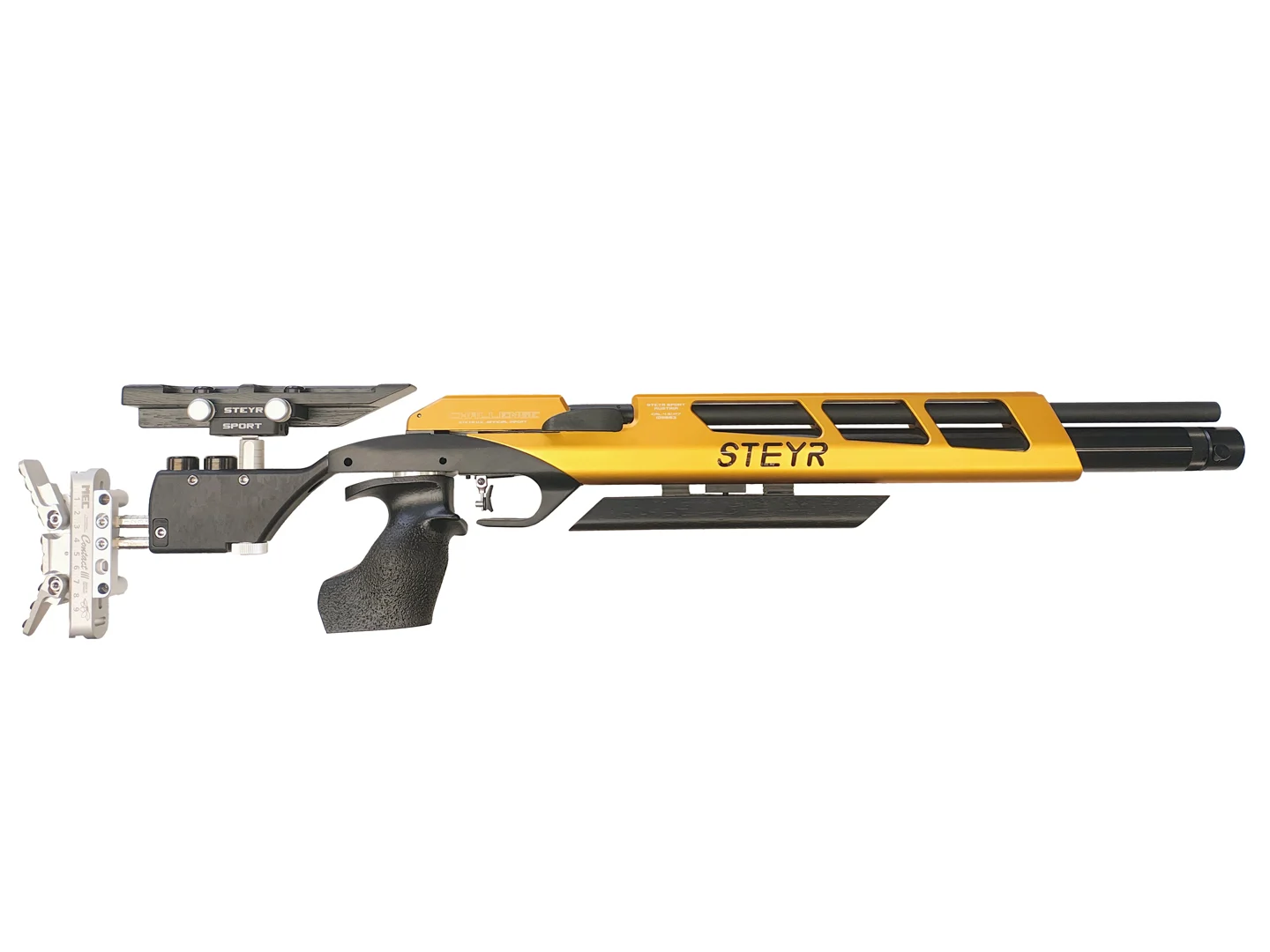
Steyr Challenge HFT Hybrid – Get rapid, accurate shots with our advanced air rifle.
Customise your fit with an adjustable buttplate, cheekpiece, grip, and forend. The 450mm Ilaflon coated barrel and STEYR Stabilizer ensure top precision.
Safety is key: no projectile stays in the gun after magazine removal, plus there’s an extra safety.
Steyr Challenge HFT Hybrid Specifications:
- Total Length: 910mm
- Total Height: 175mm
- Barrel Length: 450mm
- Total Weight: 3730g
- Trigger: Mechanical
- Trigger Pull:50-250g
Please Note Scope Not Included
Description
Steyr Challenge HFT Hybrid
A Precision-Engineered Hybrid Air Rifle Designed for Competitive Excellence
Precision shooting has long been defined by the pursuit of balance, control, and repeatable accuracy. Within that pursuit, innovation has continuously reshaped what competitive shooters can expect from their equipment. The Steyr Challenge HFT Hybrid has been positioned precisely at that intersection, where advanced engineering meets real-world competitive demands. Rather than being designed for a single shooting discipline alone, a hybrid performance philosophy has been embraced to support adaptability, consistency, and shooter confidence across varied environments.
Built with inclusivity in mind, the Steyr Challenge HFT Hybrid has been developed to support shooters of different experience levels, physical builds, and competitive goals. Every design decision has been informed by field target principles, hunter field target requirements, and the evolving expectations of modern precision shooting communities. As a result, performance has not merely been promised; it has been systematically engineered and delivered.
Understanding the Steyr Challenge HFT Hybrid Concept
Why a Hybrid Platform Was Needed
Over time, traditional air rifle platforms have been optimized either for Field Target (FT) or Hunter Field Target (HFT), often forcing shooters to compromise when transitioning between disciplines. With the Steyr Challenge HFT Hybrid, that limitation has been intentionally addressed. A hybrid architecture has been adopted so that competitive flexibility can be achieved without sacrificing accuracy, ergonomics, or reliability.
Rather than modifying an existing platform superficially, a ground-up approach has been applied. Engineering priorities have been aligned with the real conditions shooters face during competition. Environmental variability, shooting posture changes, and time pressure have all been considered during development. Consequently, performance stability has been improved while user fatigue has been reduced.
What “Hybrid” Means in Practical Terms
Within the Steyr Challenge HFT Hybrid, the term hybrid should be understood as functional integration rather than marketing abstraction. Multiple competitive requirements have been merged into a single, cohesive system. Balance characteristics suitable for standing, kneeling, and prone positions have been preserved. Meanwhile, adjustability has been integrated discreetly to remain compliant with competition regulations.
By doing so, a rifle has been produced that supports adaptability without introducing unnecessary complexity. Shooters are therefore empowered to focus on technique and strategy rather than constant equipment adjustments.
Steyr Arms Legacy and Engineering Philosophy
A Heritage of Precision Manufacturing
Steyr Arms has long been associated with engineering excellence, and that heritage has been carried forward into the Steyr Challenge HFT Hybrid. Manufacturing standards have been maintained at a level where tolerances are tightly controlled and material selection is purpose-driven. As a result, long-term reliability has been ensured even under demanding competitive use.
Rather than relying on outsourced shortcuts, production processes have been refined to preserve consistency from unit to unit. Each component has been designed to contribute meaningfully to overall performance. Consequently, the finished system has been recognized for its predictability and mechanical integrity.
Shooter-Centric Design Decisions
Throughout development, feedback loops with competitive shooters have been emphasized. Real-world insights have been incorporated to ensure that the Steyr Challenge HFT Hybrid feels intuitive from the first handling. Controls have been positioned for natural reach. Weight distribution has been calibrated to minimize strain during extended sessions.
Importantly, inclusivity has been prioritized. The platform has been designed to accommodate a wide range of shooters without requiring extensive customization. This approach has helped ensure that newcomers and seasoned competitors alike can achieve confident handling and repeatable results.
First Impressions and Build Quality
Materials Chosen for Performance and Longevity
High-grade materials have been selected to balance durability with weight efficiency. Structural rigidity has been enhanced while unnecessary mass has been avoided. Through this approach, vibration management has been improved and shot-to-shot consistency has been supported.
Surface finishes have been applied not only for visual appeal but also for protection against wear and environmental exposure. As a result, the Steyr Challenge HFT Hybrid has been prepared for outdoor competitive conditions without compromising aesthetics.
Assembly and Fit Consistency
During assembly, precision alignment has been prioritized. Moving components have been fitted to ensure smooth operation and predictable behavior. By maintaining strict quality control, performance variance has been minimized. Consequently, confidence in equipment reliability has been reinforced from the outset.
Technical Architecture of the Steyr Challenge HFT Hybrid
Engineering Precision for Competitive Reliability
Engineering excellence within competitive air rifles is rarely achieved through isolated innovation. Instead, performance is refined through the deliberate integration of mechanical systems that operate predictably under pressure. With the Steyr Challenge HFT Hybrid, a cohesive technical architecture has been implemented to support consistency, control, and long-term reliability. Each subsystem has been engineered not as a standalone feature, but as a contributor to the overall shooting experience.
By focusing on mechanical harmony rather than extreme specialization, a platform has been produced that supports precision across varied shooting scenarios. Consequently, competitive performance has been stabilized while equipment-induced variables have been reduced.
Action Design and Mechanical Consistency
Precision-Centered Action Engineering
At the core of the Steyr Challenge HFT Hybrid, a refined action system has been implemented to support repeatable shot execution. Mechanical tolerances have been maintained at exceptionally tight levels. Through this approach, internal alignment has been preserved, and energy transfer has been optimized.
Rather than relying on excessive complexity, simplicity has been embraced where reliability benefits could be realized. As a result, mechanical wear has been minimized and long-term consistency has been enhanced. Competitive shooters have therefore been provided with a system that behaves predictably over extended use.
Shot Cycle Optimization
Shot cycle behavior has been carefully managed to minimize disruption during firing. Energy release has been controlled so that recoil impulse remains subtle and linear. By reducing sudden movement, sight picture retention has been improved, especially during offhand and kneeling shots.
This refinement has been achieved through internal balancing and controlled airflow management. Consequently, follow-through has been supported without requiring conscious compensation from the shooter.
Power System and Air Management
Regulated Performance Stability
Within the Steyr Challenge HFT Hybrid, power delivery has been regulated to ensure consistency across the usable shot range. Pressure variation has been tightly controlled so that velocity deviation is minimized. Through this regulation strategy, vertical stringing at distance has been reduced.
Importantly, the system has been tuned to remain compliant with competition power limits. Rather than pushing output unnecessarily, usable efficiency has been prioritized. This approach has allowed predictable pellet behavior to be maintained under match conditions.
Efficient Air Utilization
Air efficiency has been improved through optimized valve timing and internal flow paths. By ensuring that only the required volume of air is released per shot, waste has been minimized. Consequently, a practical shot count has been achieved without sacrificing consistency.
This efficiency also contributes to thermal stability. As pressure changes occur more gradually, system behavior remains predictable across longer shooting sessions.
Trigger System Design and Control
Predictable Trigger Behavior
Trigger performance plays a defining role in precision shooting outcomes. With the Steyr Challenge HFT Hybrid, a refined trigger system has been implemented to support deliberate shot release. Travel characteristics have been tuned to feel consistent from shot to shot. Creep has been minimized, and break behavior has been engineered to remain predictable.
Rather than offering excessive adjustability that can complicate setup, meaningful adjustments have been provided. Through this balance, shooters are empowered to fine-tune feel without introducing instability.
Passive Safety and Confidence
Safety mechanisms have been integrated in a manner that does not interfere with competitive rhythm. Engagement has been designed to be intuitive and unobtrusive. As a result, confidence has been maintained without distraction, even during high-pressure competition environments.

Barrel System and Accuracy Foundations
Barrel Manufacturing Standards
Accuracy expectations within competitive shooting demand rigorous barrel quality. For the Steyr Challenge HFT Hybrid, barrels have been manufactured using precision processes designed to maintain uniformity along the entire bore. Internal finish quality has been prioritized to support consistent pellet engagement.
Through careful quality control, variance between barrels has been reduced. As a result, accuracy performance remains reliable across production units.
Pellet Compatibility and Consistency
Pellet compatibility has been considered throughout barrel design. Rather than favoring a narrow selection, tolerance has been balanced to accommodate a range of high-quality competition pellets. This flexibility allows shooters to select ammunition based on availability and preference without compromising accuracy.
Balance, Weight Distribution, and Control
Optimized Center of Gravity
Handling stability has been addressed through deliberate weight distribution. The center of gravity has been positioned to support neutral balance across common shooting positions. By avoiding front-heavy or rear-heavy bias, fatigue has been reduced during extended matches.
This balance also contributes to smoother transitions between targets. As a result, time management during competition has been improved.
Passive Stability Enhancements
Rather than relying on add-on weights, inherent stability has been engineered into the platform. Structural stiffness and mass placement have been coordinated to dampen unwanted movement. Through this passive approach, steadiness has been improved without increasing overall complexity.
Ergonomics and Shooter Interface Design
How the Steyr Challenge HFT Hybrid Supports Confident Control
Ergonomic efficiency has been recognized as a decisive factor in competitive shooting performance. While mechanical precision establishes technical potential, consistent results are often determined by how intuitively a platform interfaces with the shooter. With the Steyr Challenge HFT Hybrid, human-centered design has been prioritized to ensure that control, comfort, and confidence are sustained throughout every stage of competition.
Rather than forcing shooters to adapt to rigid geometry, adaptability has been integrated in a subtle and competition-compliant manner. Through this approach, natural alignment has been encouraged, and physical strain has been reduced during extended sessions.
Stock Architecture and Structural Geometry
Neutral Geometry for Multi-Position Shooting
Stock geometry within the Steyr Challenge HFT Hybrid has been configured to support standing, kneeling, and prone shooting positions without favoring a single stance. A neutral structural profile has been maintained so that balance and alignment remain consistent as shooting posture changes.
By avoiding extreme contours, transition time between positions has been minimized. Consequently, efficiency during timed competition stages has been enhanced.
Structural Rigidity Without Excess Weight
Material selection within the stock has been guided by the need for rigidity rather than mass. Flex has been controlled so that point-of-impact consistency is preserved. At the same time, unnecessary weight has been avoided to reduce fatigue.
Through this balance, the platform remains stable without becoming burdensome during prolonged matches.
Grip Design and Hand Placement
Natural Wrist Alignment
Grip geometry has been refined to promote a relaxed wrist position. By encouraging natural hand alignment, muscular tension has been reduced. This reduction contributes directly to steadier aim and improved trigger control.
Surface texturing has been applied thoughtfully to provide secure contact without discomfort. As a result, confident handling is maintained even in variable weather conditions.
Inclusive Grip Dimensions
Rather than assuming a single hand size or shooting style, inclusive dimensions have been adopted. This design choice allows a broader range of shooters to achieve proper contact and control without modification. Consequently, accessibility within competitive communities has been strengthened.
Cheek Rest and Sight Alignment
Consistent Head Positioning
Sight alignment consistency depends heavily on repeatable head positioning. With the Steyr Challenge HFT Hybrid, cheek support has been designed to encourage stable placement without pressure points. By supporting relaxed contact, visual alignment becomes more predictable.
This stability reduces the need for conscious adjustment between shots. As a result, mental focus can remain on target execution.
Competition-Compliant Adjustability
Adjustability has been integrated discreetly to remain within competition regulations. Meaningful fine-tuning is therefore possible without introducing complexity. Once set, adjustments remain secure, reinforcing confidence during movement and handling.
Length of Pull and Body Adaptability
Supporting Diverse Physical Builds
Shooters come from diverse backgrounds and physical builds. Recognizing this diversity, length-of-pull accommodation has been incorporated into the Steyr Challenge HFT Hybrid design philosophy. Through adaptable geometry, proper shoulder placement can be achieved by a wide range of users.
This adaptability ensures that posture remains natural rather than forced. Consequently, endurance and control are improved.
Stability Through Proper Fit
Proper fit directly influences recoil management and follow-through. When alignment is correct, movement during firing is reduced. The Steyr Challenge HFT Hybrid supports this alignment by maintaining ergonomic consistency across different configurations.
Control Placement and Intuitive Operation
Reach Without Disruption
Controls have been positioned to allow operation without breaking shooting position. By minimizing unnecessary movement, rhythm and concentration are preserved. This intuitive layout supports smoother shot sequences under competitive pressure.
Through consistent placement, muscle memory develops naturally over time. As a result, efficiency improves with continued use.
Reduced Cognitive Load
Complex systems often increase cognitive load during competition. With the Steyr Challenge HFT Hybrid, simplicity has been prioritized. By limiting unnecessary adjustments, mental resources can remain focused on wind reading, range estimation, and execution.
Real-World Performance and Competitive Use Cases
How the Steyr Challenge HFT Hybrid Performs Where It Matters Most
Laboratory accuracy figures and controlled testing environments only reveal part of a rifle’s potential. True performance is ultimately measured during competition, where variables such as wind, terrain, fatigue, and time pressure shape outcomes. With the Steyr Challenge HFT Hybrid, real-world behavior has been prioritized so that technical capability translates reliably into competitive success.
Rather than being optimized solely for ideal conditions, performance consistency has been engineered for unpredictability. Through this philosophy, confidence is reinforced not just during practice, but throughout full match cycles.
Accuracy Behavior Under Match Conditions
Repeatable Grouping Across Distances
During competitive use, consistent grouping across varied distances is essential. The Steyr Challenge HFT Hybrid has been engineered to maintain predictable pellet behavior from close-range targets to extended distances typical of HFT courses. By stabilizing velocity and minimizing shot cycle disturbance, vertical dispersion has been reduced.
As a result, confidence in holdover calculations is strengthened. When environmental variables change, predictable mechanical behavior allows shooters to adapt more effectively.
Practical Accuracy Versus Theoretical Potential
Rather than chasing extreme benchrest figures that rarely reflect field conditions, practical accuracy has been emphasized. Performance has been tuned to remain reliable from unsupported positions. This focus ensures that gains achieved during training are retained during competition.
Through this approach, skill execution becomes the dominant variable rather than equipment unpredictability.
Stability in Standing, Kneeling, and Prone Positions
Offhand Control and Balance
Standing shots often represent the most demanding aspect of HFT competition. With the Steyr Challenge HFT Hybrid, balance characteristics have been refined to support steadiness without requiring excessive muscular effort. The neutral center of gravity contributes to controlled sway rather than abrupt movement.
By reducing fatigue accumulation, offhand consistency is maintained deeper into matches.
standard for HFT competition Kneeling and Prone Adaptability
When transitioning to kneeling or prone positions, stability requirements change. The Steyr Challenge HFT Hybrid has been designed to adapt naturally without requiring reconfiguration. Structural geometry supports solid contact points, allowing shooters to settle quickly.
Consequently, transition efficiency is improved, and time management becomes less stressful.
Wind Management and Environmental Variability
Predictable Pellet Behavior
Wind reading remains a critical skill in HFT shooting. While no rifle can eliminate environmental influence, predictable pellet behavior allows shooters to interpret conditions accurately. With the Steyr Challenge HFT Hybrid, consistent muzzle velocity and barrel behavior reduce unexplained deviation.standard for HFT competition
As a result, wind corrections become more reliable and repeatable.
Temperature and Pressure Stability
Environmental conditions can affect air systems through pressure and temperature variation. By controlling air flow efficiency and regulation behavior, the Steyr Challenge HFT Hybrid maintains stable performance across changing conditions. This stability reduces the need for constant recalibration during outdoor matches.
Endurance and Fatigue Management
Designed for Full-Day Competitions
HFT matches often extend over several hours. Fatigue management therefore becomes a decisive factor. With optimized weight distribution and ergonomic efficiency, physical strain has been reduced. As a result, shooting form remains more consistent toward the end of competition.
This endurance advantage can influence outcomes significantly when margins are narrow.
Mental Focus and Equipment Confidence
When equipment behavior remains predictable, cognitive load is reduced. Shooters are freed from second-guessing mechanical performance. With the Steyr Challenge HFT Hybrid, confidence in equipment reliability allows mental energy to be directed toward strategy and execution.
Competitive Scenarios and Use Case Versatility
Hunter Field Target Competition
Within HFT environments, compliance and adaptability are essential. The Steyr Challenge HFT Hybrid has been developed to align with competition requirements while offering refined control. Its balanced design supports the varied shot presentations encountered during HFT courses.
Training and Skill Development
Beyond competition, the platform serves as an effective training tool. Consistent feedback allows technique refinement to be accelerated. Shooters are able to identify and correct errors with clarity, reinforcing long-term development.
Precision Recreation and Club Events
For shooters engaged in club-level events or precision-focused recreation, the Steyr Challenge HFT Hybrid delivers a rewarding experience. Reliability and accuracy combine to support enjoyment as well as progression.
Additional information
| Caliber | .177 |
|---|---|
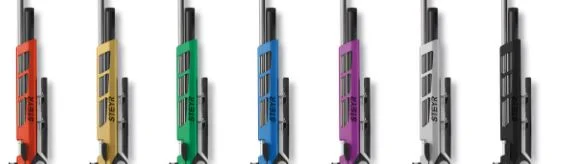
| color | Black, Blue, Red, Gold, Green, Purple |
Related products
-
Steyr Hunting 5
Price range: €2,769.00 through €2,885.00Select options This product has multiple variants. The options may be chosen on the product page -
Steyr Challenge HFT
€2,945.00Select options This product has multiple variants. The options may be chosen on the product page -
Steyr LP2 Pistol
€1,400.00Select options This product has multiple variants. The options may be chosen on the product page -
Steyr LP2 Compact
€1,490.00Select options This product has multiple variants. The options may be chosen on the product page
Reviews
There are no reviews yet.