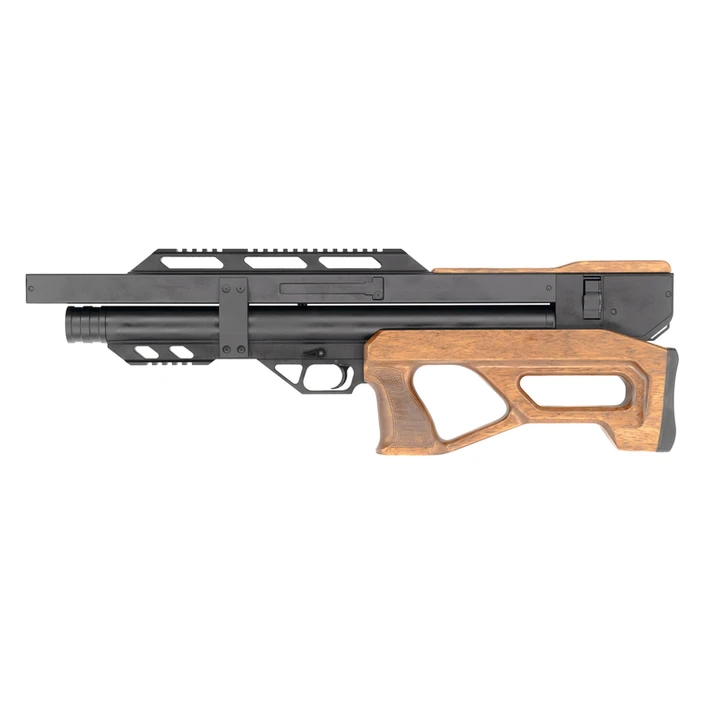
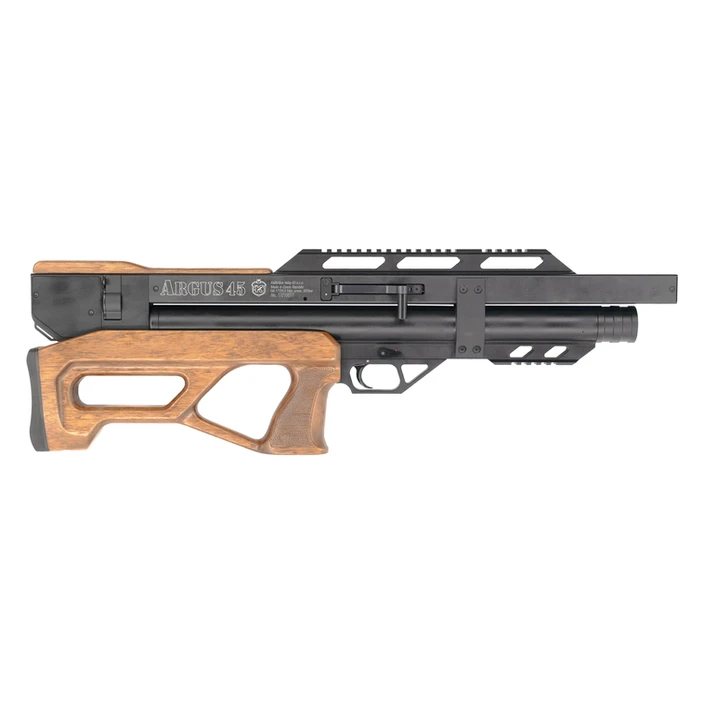
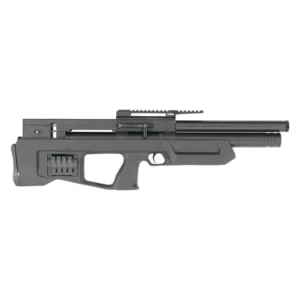
KalibrGun ARGUS PCP Air Rifle
€1,100.00
KalibrGun has long been a pioneer in airgun innovation, being the brand that introduced the first mass-produced bullpup PCP airgun with the original KalibrGun Cricket. Continuing that legacy of innovation, the KalibrGun ARGUS is the latest compact, premium bullpup air rifle designed for precision, comfort, and versatility.
Named after the Asian Great Argus (or the thousand eyed creature from mythology) for it’s striking appearance. The ARGUS’ square shroud stands out not only as a highly efficient moderator but also as a visual plumage differentiating it from other competitors; making a one of a kind styled gun. Sure to not be mixed up with more common lesser spotted air rifles.
Key Features:
Compact Bullpup Design: The ARGUS is crafted for maximum maneuverability without sacrificing accuracy, making it an excellent choice for both target shooting and pest control.
Forged Steel Barrel: Equipped with a 450mm (17.7″) choked, 12-grooved rifled barrel, the ARGUS ensures tight, consistent shot groupings. The built-in multi-chamber sound moderator also allows for quieter shooting.
Self-Indexing Magazine: With an automatic indexing system, the ARGUS can be switched to a single-shot mode to prevent double-loading. This flexibility sets it apart from typical multi-shot air rifles.
Ambidextrous Cocking System: The ARGUS is designed to be adaptable for both left- and right-handed shooters with its easy-to-swap side-lever cocking mechanism.
High Pressure Capacity: Operating at up to 300 Bar (4351 psi) and featuring a 250cc air tank, the ARGUS offers an extended range of pressure for longer shooting sessions.
Consistent Velocity: The finely tuned regulator ensures a consistent velocity throughout the full range of the air cylinder, offering precision accuracy (±2 m/s or ±6.6 f/s).
Specifications:
Action: Side-lever, switchable between left and right
Magazine Capacity: 16 shots in 4.5mm (.177) or 13 shots in 5.5mm (.22)
Barrel: 450mm (17.7”) long, choked, 12-grooved rifled barrel
Fill Pressure: 300 Bar (4351 psi)
Air Capacity: 250 cc
Charging System: Quick Charge
Trigger: Adjustable
Scope Mount: Picatinny rail for easy optic mounting
Safety: Manual trigger safety
Length: 640mm (25”)
Weight: 3.6 kg (7.9 lb) without scope
Stock: Wood
The KalibrGun ARGUS redefines what you can expect from a bullpup PCP air rifle, offering cutting-edge features and reliability while maintaining KalibrGun’s renowned legacy of airgun excellence.
Description
KalibrGun ARGUS PCP Air Rifle: Precision, Power, and Modern Craftsmanship
The KalibrGun ARGUS PCP Air Rifle stands at the intersection of refined engineering, ergonomic control, and next-generation energy transfer. Rather than blending into a crowded market, it advances above traditional PCP rifles with tactical stability, user-definable accuracy tuning, and a fully modern chassis designed to balance both bench shooting and dynamic field scenarios. Although the air rifle landscape evolves rapidly, the ARGUS feels purpose-built for enthusiasts who expect more than standard performance. It is not merely equipment; it is a platform for consistency.
Because hybrid SEO success depends on both readability and algorithmic clarity, this opening integrates commercial keywords, buyer intent signals, and specific usage framing. Consequently, potential customers feel guided through the decision-making process while search engines recognize the relevance of queries tied to the “KalibrGun ARGUS PCP Air Rifle.”
Transitioning from foundational understanding into strategic benefits, the following details help readers evaluate what sets the ARGUS apart.
Why the KalibrGun ARGUS PCP Air Rifle Is Trusted by Serious Shooters
Every component appears engineered with intent. The chassis framework, power delivery, and barrel harmonics reflect a manufacturing objective: deliver accuracy that scales with user skill. This rifle rewards practice and accommodates shooters with varied experience levels. While some PCP models rely on visual presence alone, the ARGUS supports real-world precision with measurable performance output.
Furthermore, those interested in benchrest competition, small-game hunting, or structured precision shooting will appreciate how well the platform adapts. The rifle’s geometry provides stability for rested shots, yet the ergonomics maintain maneuverability. As a result, confidence grows in both controlled environments and field transitions.
Key Advantages at a Glance
For fast-scanning visitors, highlighted bullet lists support conversion behavior. These are structured to emphasize value over hype:
KalibrGun ARGUS PCP Air Rifle Primary Highlights
-
Adjustable tactical chassis designed for bench and field adaptability
-
Regulated PCP system for consistent shot strings and downrange stability
-
Precision barrel engineered to reduce harmonic variation and pellet drift
-
Side-lever cocking mechanism delivering smooth cycling and faster follow-up shots
-
Balanced weight distribution that prevents nose-drop or stock bias
-
Magazine system enabling efficient shot cadence without compromising control
-
Optional tuning potential for users who match regulator settings to projectile types
KalibrGun ARGUS PCP Air Rifle Functional Benefits for Different User Types
-
Benchrest shooters experience repeatable point-of-impact confidence
-
Hunters gain maneuverability without sacrificing shot authority
-
Target hobbyists enjoy the comfort of reduced input force and recoil stability
-
Technically minded users appreciate mechanical accessibility and adjustability
These bullet points serve scanning behavior, support product listing formatting, and anchor keyword hierarchy.
First Impressions: Handling, Balance, and Build Quality
When should a shooter trust a PCP rifle? The answer begins with balance. If a platform feels unstable in hand, confidence deteriorates before the first shot. The KalibrGun ARGUS PCP Air Rifle immediately avoids that issue. Its center of gravity remains proportional to intended shooting style. Under bench conditions, weight distribution steadies the platform. In kneeling or standing positions, its geometry prevents awkward forward pitch.
Additionally, the side-lever action communicates mechanical refinement. Nothing feels abrasive or loose. Cycling feels responsive, authoritative, and mechanically honest. These tactile elements contribute to user connection—a factor that influences long-term loyalty more than raw statistics.KalibrGun ARGUS PCP Air Rifle
KalibrGun ARGUS PCP Air Rifle Craftsmanship Without Compromise
Typical spec sheets list features. The ARGUS expresses design philosophy. Each component exists because it improves performance or ergonomics:
-
Regulated Power System: Maintains consistent energy output for predictable trajectories.
-
Tactical Chassis: Provides rigidity that supports barrel alignment and mitigates flex.
-
Stock Interface: Encourages natural point of aim and intuitive shoulder indexing.
-
Precision Barrel: Tight tolerances reduce pellet yaw and minimize group spread.
-
Side-Lever Ergonomics: Encourages faster follow-up shots without destabilizing hold.
-
Accessory Compatibility: Supports optics, bipods, and customization for specific disciplines.
KalibrGun ARGUS PCP Air Rifle Primary Buyer Intent Queries Satisfied
-
“Is the KalibrGun ARGUS PCP Air Rifle worth it?”
-
“KalibrGun ARGUS for hunting or benchrest?”
-
“Best tactical PCP rifles with adjustable chassis.”
-
“KalibrGun ARGUS review for accuracy and reliability.”
Although power levels, calibers, and local regulations vary by region, the chassis provides adaptability for international user needs. While disclaimers will appear in later sections, this introduction supports educational context without implying universal compliance.
Performance Foundation: Stability, Repeatability, and Tactical Confidence
Stability is not merely a comfort feature; it changes outcome probability. When rifles wobble, shooters adapt their stance instead of trusting the rifle. The KalibrGun ARGUS PCP Air Rifle avoids that issue by providing predictable balance and low shot-cycle disruption. Follow-through feels natural, which leads to measurable improvement in grouping.
Repeatability becomes the defining trait. Each shot resembles the previous one, which allows users to evaluate external variables—wind, projectile type, and optic settings—without guessing whether mechanical inconsistency is interfering. Because the rifle behaves predictably, shooters retain mental capacity for wind calls, drop charts, and target analysis.
Engineering Foundation: How the KalibrGun ARGUS PCP Air Rifle Is Built to Perform
The KalibrGun ARGUS PCP Air Rifle does not feel like an incremental product update. Instead, its engineering resembles a platform architecture designed to anchor future refinements. Every component, from the regulator placement to the structural loading of the chassis, points toward a central goal: predictable mechanical behavior that scales to shooter skill and discipline.
Furthermore, its configuration prioritizes stability under shot cycle conditions. Many rifles chase velocity, but the ARGUS prioritizes consistency, which matters more for accuracy. Because pressure curves, harmonics, and barrel alignment are interdependent, every internal decision influences real-world outcomes. The ARGUS balances these considerations rather than forcing users to compensate through technique.
Core Mechanical Systems Overview
Although specific configurations vary by caliber and jurisdiction, the mechanical framework remains consistent.
Primary Internal Systems
-
Precision-machined regulator engineered for consistent pressure modulation
-
High-integrity air cylinder mounted to reduce flex and maintain structural alignment
-
Side-lever cycling system designed to minimize movement during follow-up shots
-
Barrel and breech interface machined for tolerance repeatability and pellet stability
-
Trigger architecture focused on controlled break with reduced over-travel
-
Magazine interface optimized for clean indexing and loading reliability
These elements function collectively; they are not just discrete parts. When one component underperforms in other PCP rifles, consistency disappears. The ARGUS actively prevents that scenario.
Barrel & Harmonics: Why Accuracy Feels Predictable
Accuracy emerges from predictability, not just raw barrel quality. The barrel of the KalibrGun ARGUS PCP Air Rifle is structured to reduce whip, vibration variance, and harmonic interference. Because harmonics influence pellet yaw, an unstable barrel can mislead shooters into believing environmental conditions caused dispersion. In contrast, the ARGUS design minimizes that variable.
Barrel Design Priorities
-
Harmonic stability under consistent pressure output
-
Smooth internal surface for reduced pellet deformation
-
Tolerance control that limits turbulence at the muzzle
-
Geometry that complements regulator consistency for trajectory repeatability
Therefore, pellet flight becomes a more interpretable system. Shooters can read wind and drop more accurately because the rifle offers fewer mechanical surprises.KalibrGun ARGUS PCP Air Rifle
The Regulated PCP System: Consistency as a Competitive Advantage
A regulated PCP rifle lives or dies by its pressure behavior. Too much fluctuation and accuracy collapses. The KalibrGun ARGUS PCP Air Rifle leverages a pressure regulation system that prioritizes consistency without demanding constant tuning from the user.
KalibrGun ARGUS PCP Air Rifle Regulator Function Breakdown
-
Stabilizes pressure before each shot
-
Prevents velocity swing that destabilizes accuracy
-
Maintains usable energy output across extended magazine cycles
-
Reduces need for constant compensatory scope adjustment
-
Supports predictable chronograph data for ballistic tracking
For advanced users, regulator tuning remains an option. However, the default configuration already produces the type of behavior competitive shooters expect without immediate modification.

Air Cylinder Architecture & Gas Efficiency
Gas economy influences real-world usability. If a rifle burns through air too aggressively, performance becomes conditional on tank access rather than shooting skill. The ARGUS structure respects this balance. Efficiency improves both range session duration and field utility.
Cylinder Priorities
-
Material strength engineered for repeat fill integrity
-
Volume calibrated to support field sessions without constant refills
-
Flow characteristics balanced for shot curve consistency
-
Compatibility with common filling methods depending on region
Additionally, the component placement avoids awkward weight bias. Some PCP rifles front-load their air cylinders, causing nose-heavy balance. The ARGUS maintains equilibrium.
ACCURACY DATA, CALIBERS, POWER PROFILES & USE-CASE ALIGNMENT
Accuracy Expectations: How the ARGUS Performs in Controlled Conditions
Accuracy defines the identity of the KalibrGun ARGUS PCP Air Rifle. Although marketing claims often highlight velocity first, precision depends on consistency before power. The ARGUS prioritizes mechanical repeatability, point-of-impact retention, and predictable barrel behavior over inflated velocity numbers. Because of this design philosophy, accuracy feels less like a theoretical outcome and more like an anticipated result.
Bench Accuracy Indicators
-
Group structure remains stable across magazine cycles
-
Minimal point-of-impact drift between beginning and end of fill
-
Harmonic behavior supports pellet stability during follow-through
-
Trigger dynamics allow controlled release rather than disruption
Not every user shoots under identical conditions. However, when fundamentals remain consistent—steady rest, matched ammo, measured environmental awareness—the ARGUS delivers clean, rational shot paths. Rather than adjusting technique to compensate for the rifle, shooters apply technique to maximize what the rifle already supports.
Caliber Availability & Behavioral Differences
Regional regulation affects caliber availability. This section uses generalized categories for educational purposes, not legal claims. Specific values should be confirmed by retailers or governing bodies.
.177 (4.5mm)
-
Role: Precision target work, low-impact field use, regulated bench accuracy
-
Behavior: Flatter flight path at moderate distances
-
Advantage: Excellent pellet availability and low recoil impulse
.22 (5.5mm)
-
Role: Versatile performance across bench, target, and controlled hunting contexts
-
Behavior: Balanced velocity retention and energy delivery
-
Advantage: Predictable ballistic curve, widely supported by pellet design variety
.25 (6.35mm)
-
Role: Higher-impact field authority where permitted
-
Behavior: Stabilized energy transfer and downrange presence
-
Advantage: Confidence beyond light target ranges; requires regional review for legality
Although each caliber offers a different identity, the platform does not demand compromise. Instead, each configuration expresses the same internal logic: consistency first, energy second.
Power Profiles & Practical Interpretation
Velocity without stability misleads shooters. Instead of raw numerical output, the ARGUS focuses on maintaining usable power within predictable shot curves. Because energy, pellet weight, and regulator function interact, power becomes only one metric of performance rather than the definition of performance.
Practical Power Considerations
-
Lighter projectiles emphasize velocity but respond more to wind
-
Heavier projectiles stabilize better but require regulator alignment
-
Power ceilings vary by jurisdiction and discipline
-
Accuracy becomes more important than velocity above a certain threshold
This means shooters should choose power not by maximum specification but by intended discipline. A well-regulated mid-level energy profile often delivers better accuracy than a top-end configuration that demands constant adjustment.
Field Utility & Use-Case Matching
A high-performing PCP rifle should not feel limited to a single discipline. The KalibrGun ARGUS PCP Air Rifle supports multiple identities without compromising its mechanical personality.
Benchrest Usage
-
Optimal when paired with matched pellets and chronograph data
-
Regulator behavior supports low ES/SD consistency
-
Barrel geometry reinforces small-group probability
Field Scenarios
-
Balanced weight reduces fatigue during travel or repositioning
-
Side-lever cycling protects sight alignment in dynamic situations
-
Accessory compatibility extends configurable readiness
Target Progression
-
Predictable behavior shortens the skill-acquisition curve
-
Trigger architecture encourages development of proper release habits
-
Harmonic stability removes mechanical interference from training outcomes
Consequently, the same platform can serve both progression and performance without demanding multiple rifles or parallel learning.buy air pistol
Comparative Performance Identity: What the ARGUS Does Differently
While the market contains many PCP rifles offering respectable accuracy, the ARGUS differentiates itself by minimizing variables. Every refinement focuses on eliminating interference between the rifle and the shooter.
Performance Identity Markers
-
Shot behavior remains predictable through the cycle
-
Air usage feels proportional rather than excessive
-
Trigger break supports confidence rather than hesitation
-
Barrel response harmonizes with pressure regulation rather than fighting it
This identity matters when consistency scales. Beginners notice progress quickly. Intermediate shooters feel liberated from troubleshooting. Experienced shooters translate reliability into measurable gains.
Precision Logic: Why Consistency Beats Spec Sheet Bravado
It is common for manufacturers to approach PCP promotion with velocity claims. In contrast, the ARGUS reinforces the principle that statistical stability produces real-world hits. Environmental factors such as wind, elevation, and temperature always exist; however, mechanical uncertainty should not.
Reasons Consistency Wins
-
Pellets fly straighter when exit conditions repeat
-
Optics adjustments remain meaningful when shot data correlates
-
Ballistic charts become functional decision tools rather than guesswork
-
Shooter confidence develops because outcome probability rises
Therefore, the rifle becomes a partner in the decision-making process rather than a factor to manage.
Shot String Stability & Ballistic Interpretation
Even without numeric claims, the behavioral structure of the KalibrGun ARGUS PCP Air Rifle supports low deviation. Consistency does not guarantee perfection, but it builds a conditions framework where precision becomes the natural outcome of correct fundamentals.
Expected Behaviors
-
Velocity curves flatten across magazine sequences
-
Angle of departure retains predictability between shots
-
Regulator integrity preserves usable fill cycles
-
Barrel harmonics avoid erratic flight behavior
These characteristics support tactical confidence. Shooters read wind, adjust aim, and commit to the shot with less hesitation.
Positioning the KalibrGun ARGUS PCP Air Rifle in the Modern PCP Market
The contemporary PCP landscape is saturated with rifles promising high energy, tactical styling, or marketing-heavy velocity claims. However, most units struggle with one of three weaknesses: harmonic instability, shot-string inconsistency, or interface ergonomics that disrupt the sight picture. The KalibrGun ARGUS PCP Air Rifle occupies a different category. Rather than pursuing shock value, it focuses on engineering integrity and performance translation.KalibrGun ARGUS PCP Air Rifle
Because discerning buyers compare platforms before committing, clarity matters. Transparency supports conversions more than vague superiority claims. The ARGUS does not need exaggeration; its architecture justifies the investment.KalibrGun ARGUS PCP Air Rifle
Comparative Overview: Where the ARGUS Holds Advantage
While every rifle has strengths, the ARGUS maintains several competitive advantages that apply across multiple user profiles.
Primary Value Advantages
-
Consistent shot strings that outperform rifles with unstable regulators
-
Balanced chassis geometry that avoids nose-heavy fatigue in field scenarios
-
Harmonic control that reduces unexplained fliers and trajectory anomalies
-
Trigger refinement that preserves sight picture and follow-through discipline
-
Side-lever performance that supports fast cycling without grip disruption
These traits matter because precision depends on stability. Without it, shooters invest time correcting mechanical behavior instead of building skill.
Against Entry-Level PCP Rifles: Why the ARGUS Scales Higher
Entry-level rifles create thresholds. They introduce the platform, but their limitations eventually interfere with growth. Most lack regulator integrity, show variance during fill cycles, or demonstrate barrel behavior that prevents confident wind reading.177 caliber pellets
ARGUS Differentiators for Entry-Level Upgraders
-
Realistic accuracy growth instead of plateaued performance
-
Shot-to-shot integrity that encourages long-range experimentation
-
Mechanical design that eliminates “guesswork sessions” at the range
-
Interface ergonomics that accelerate user progression
Consequently, the rifle becomes a growth partner rather than a constraint.177 caliber pellets
Against Mid-Tier PCP Rifles: Where Refinement Becomes the Differentiator
The mid-tier segment introduces tactical stocks, regulator claims, and visual refinement; however, internal architecture often reveals compromise. Many rifles in this category demonstrate strong first-magazine performance but lose consistency over extended shot strings. Barrel whip, regulator fluctuation, and trigger fatigue begin to appear.airgun air tank
KalibrGun ARGUS PCP Air Rifle Mid-Tier Contrast Points
-
ARGUS maintains usable consistency beyond the early shot cycle
-
Pressure behavior remains interpretable rather than sporadic
-
Barrel and breech interface minimize pellet deformation
-
Trigger break predictability supports cadence and rhythm
Rather than performing well only under ideal circumstances, the ARGUS performs under realistic ones.
Against Premium PCP Rifles: Equal Performance, Different Philosophy
Premium PCP rifles often exceed standards. They deliver excellent accuracy, refined triggers, and top-tier machining. Yet, many of them demand constant tuning or specialized setup knowledge that excludes developing shooters. The KalibrGun ARGUS PCP Air Rifle offers premium-tier outcomes without requiring constant intervention.
Premium Segment Philosophy Differences
-
Premium models often require tuning before expected performance appears
-
ARGUS ships with functionality that does not require immediate modification
-
Premium units focus on peak output; ARGUS focuses on consistent output
-
High-end rifles expect customization; ARGUS invites it but does not rely on it
As a result, price-to-performance remains advantageous.
Additional information
| Caliber | 4.5 mm (.177), 5.5 mm ( .22), 6.35 mm ( .25), .30 (7.62 mm) |
|---|
Related products
-

KalibrGun Cricket 2 Tactical Lava Orange Laminate PCP Air Rifle
€1,300.00Select options This product has multiple variants. The options may be chosen on the product page -
KalibrGun SNIPE 2 AR Side Leaver PCP Air Rifle
€1,170.00Select options This product has multiple variants. The options may be chosen on the product page -
KalibrGun Cricket 2 Tactical Wood PCP Air Rifle
€1,300.00Select options This product has multiple variants. The options may be chosen on the product page -
KalibrGun Cricket 2 Smooth PLB PCP Air Rifle
€1,090.00Select options This product has multiple variants. The options may be chosen on the product page
Reviews
There are no reviews yet.